
Immersive Technologies & Platforms
Task 3: Immersive Virtual Museum of Vincent Van Gogh in VR with Spatial Audio
Virtual Museum of the Vincent Van Gogh
Introduction
Technology has always transformed the world map. In the 1900s, rapid industrialization took place and suddenly changed the world’s perspective of trade and future insights. After a short time, technology started getting better and better, and so did our lives from heavy cell phones to smartphones, technology has had a huge impact on our lives and made our living standards very achievable in the 21st century. In short, technological advancement has always helped us to make our way of living better and more productive. In general, technological advances helped the other areas but also helped achieve certain milestones in augmented and Virtual realities. As society becomes digital, the demand for interactive and immersive experiences grows. This Virtual Art Gallery Project uses virtual reality (VR) technology to address and solve these challenges by giving a user-controlled and immersive experience that redefines the perspective of seeing art.
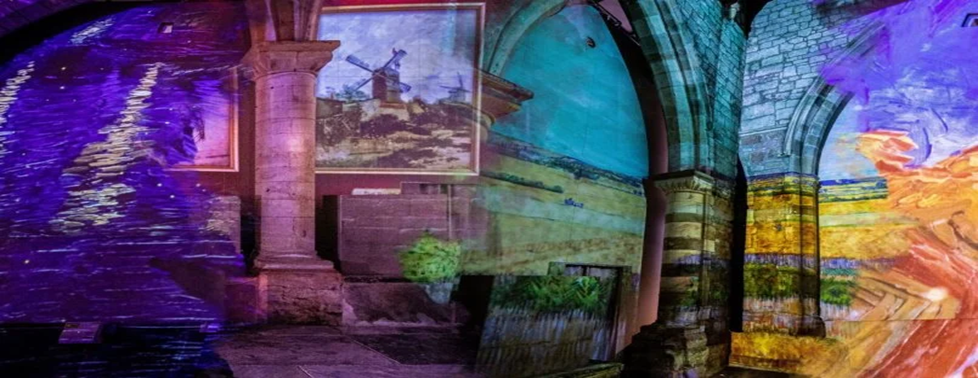
The Van Gogh Immersive Museum in York, England, is my main inspiration for this project. In there, they provided the walkthrough Virtual Experience to the user while the user can sit around and see the entire scene, which is the live paintings moving in it along with the 3D Spatial audio is used to give an immersive experience with some narration of the artworks by the speaker. That’s the foundation of this project also, but in this project, the user has control over the scene. Users can teleport anywhere in the scene and get a better view using the joysticks provided by the Meta Quest Headsets. The reason for doing this is always like humans to have some sense of control in a situation so they feel more comfortable as mentioned in the (Bandura, 1977). This reflection document has an in-depth insight into the development, features, methodologies, challenges faced during the implementation, Evaluation, and suggestions for the future.
Project Overview:
Accessibility to the arts remains a significant issue, with the geographical, physical, and economic barriers limiting access to many people and art lovers. The wave of the COVID-19 pandemic has shown a drastic effect on this area as people who want to visit the museum now need to be stuck at home, which gives a pretty good reason to invent and move towards other digital solutions that can be implemented so that everyone in the world can have access while sitting In their rooms or desired place. We have seen that our traditional methods have not been successful in overcoming these issues, so here comes the virtual reality concept that perfectly fulfills the needs of the market. moreover, it helps us to preserve our lost cultural places.
Issues This Project focuses on:
Inclusivity:
If anyone has a VR headset, they can explore the gallery as it removes the physical presence needs from anyone and gives them the freedom to learn and enjoy the environment.
Navigation:
The user uses Teleportation from one place to another as the gallery has teleportation points placed all around the gallery to get a better view of the paintings. The walking method can also be used here, but to make sure we give the user the most amount of ease and also, in VR, the user can fall or hit any object if we use a walking method that’s why I used the teleportation method instead of gradual walking.
Educational potential:
This virtual museum is also a source of learning and exploring the visual artwork, which leads to an educational perspective of learning. The target audience here is the young generation, as people are not familiar with art anymore, so we have to make sure young people use it.
The previous research that supports this virtual museum concept, (Ruíz Gándara África, 2023) states that immersive experiences elicit stronger emotional and cognitive responses, promoting user engagement and understanding. Similarly, (Schivelbusch, 1995) highlights how technological advances have historically reshaped cultural spaces, and VR now stands as the next technological platform in the transformation.
Literature Review
This Virtual Art Gallery project is based heavily on research that supports exploring the intersection of technology, culture, and arts.
Immersive Experience in Art:
Studies like (Oldfield, 2024) demonstrate how immersive art exhibitions, such as Van Gogh inspired environments, redefine traditional museum experiences by integrating technology. (Zhujianghe Zhao, 20 Aug, 2024) highlights the importance of adapting exhibition designs to align with digital trends, ensuring broader audience reach and sustained relevance.
360-Degree Interaction and Spatial Design:
As (Mondloch, 20 September 2022) explained, the success of immersive spaces depends on the seamless integration of technology and environment. The 360-degree view feature in this project enhances user immersion, providing a naturalistic exploration of the gallery.
Lightning and Natural Aesthetic:
The integration of natural lighting in the Virtual Art Gallery reflects insights from (Zhujianghe Zhao, 20 Aug, 2024) those who underscore the role of lighting in shaping the emotional atmosphere of exhibition spaces. This way of approach shows Van Gogh’s priority on nature and light in his work.
User-Controlled Navigation:
Unlike the pre-designed walkthroughs, Teleportation and spatial interaction in this project align with the findings of (Zhujianghe Zhao1, 14 October 2024) those who advocate for personalized user control in VR environments to enhance engagement and satisfaction.
Feature and Environment Design
The overall structure of the environment is optimized and made sure that it works well In Meta Quest Headset after building it in Unity. The main features of this project have been stated as follows:
360-Degree Exploration:
Users can rotate their headsets as it’s a VR environment, and the environment in the model has been placed and used very carefully, along with adding perfectly matched Artwork on the wall so no artifacts will be shown while rendering or running the scene while the user sees it from any angle.
Teleportation:
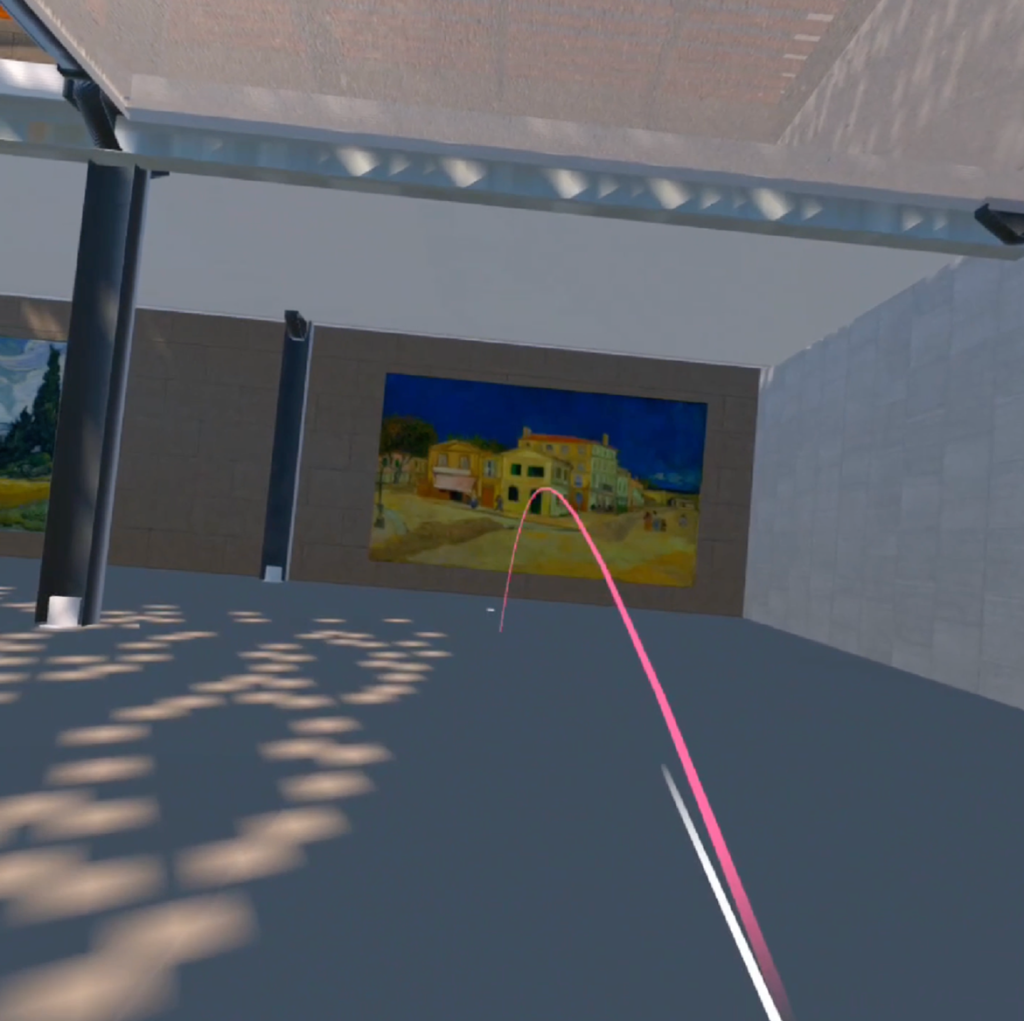
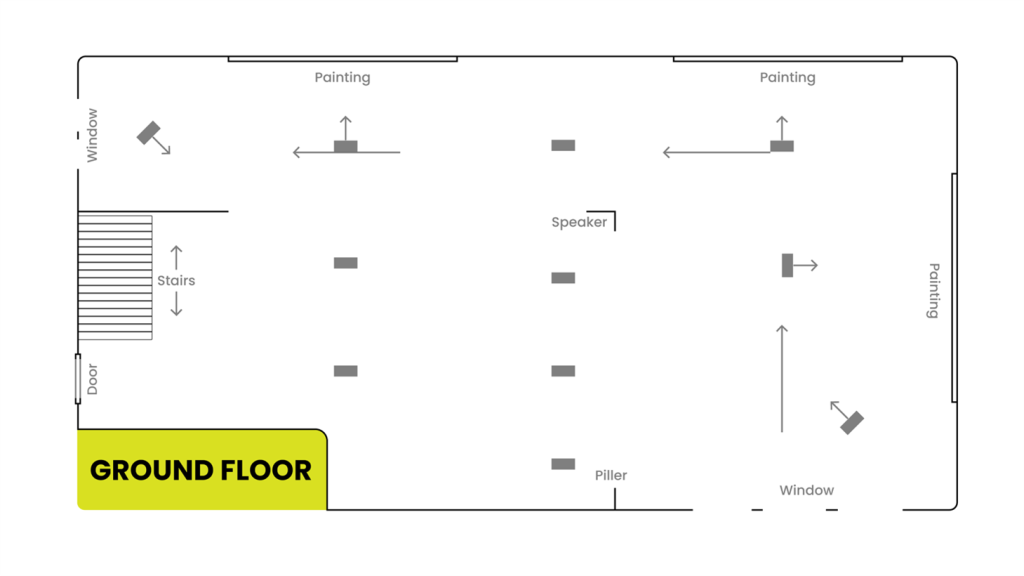
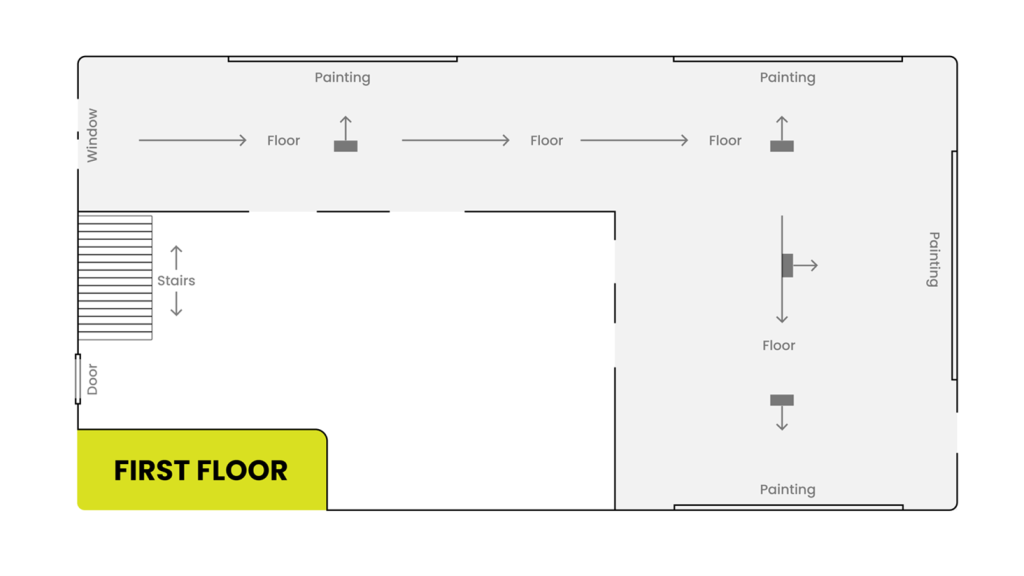
Teleportation is the main navigation system in the scene, and the user can only move if he uses these points placed and scattered all across the ground of the Museum and also on the upper floor of the building. Smooth transitions prevent disorientation, ensuring the amount of accessibility for new users to VR.
Natural and Artificial Lighting:
The gallery incorporates natural lighting effects, such as sunlight streaming through windows, complemented by strategically placed artificial lights in the outdoor scene to make sure the museum is fully lit with the outside light and doesn’t need to add indoor lighting to make sure everything looks natural.
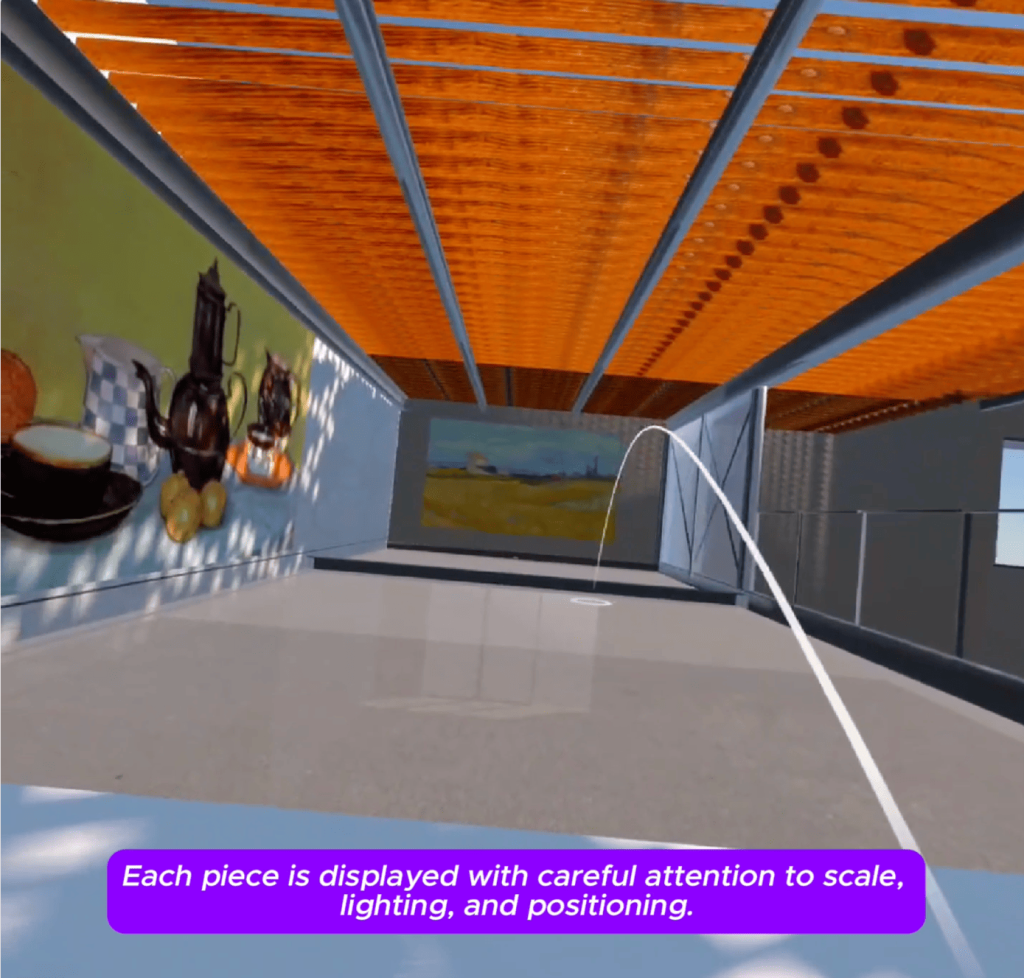
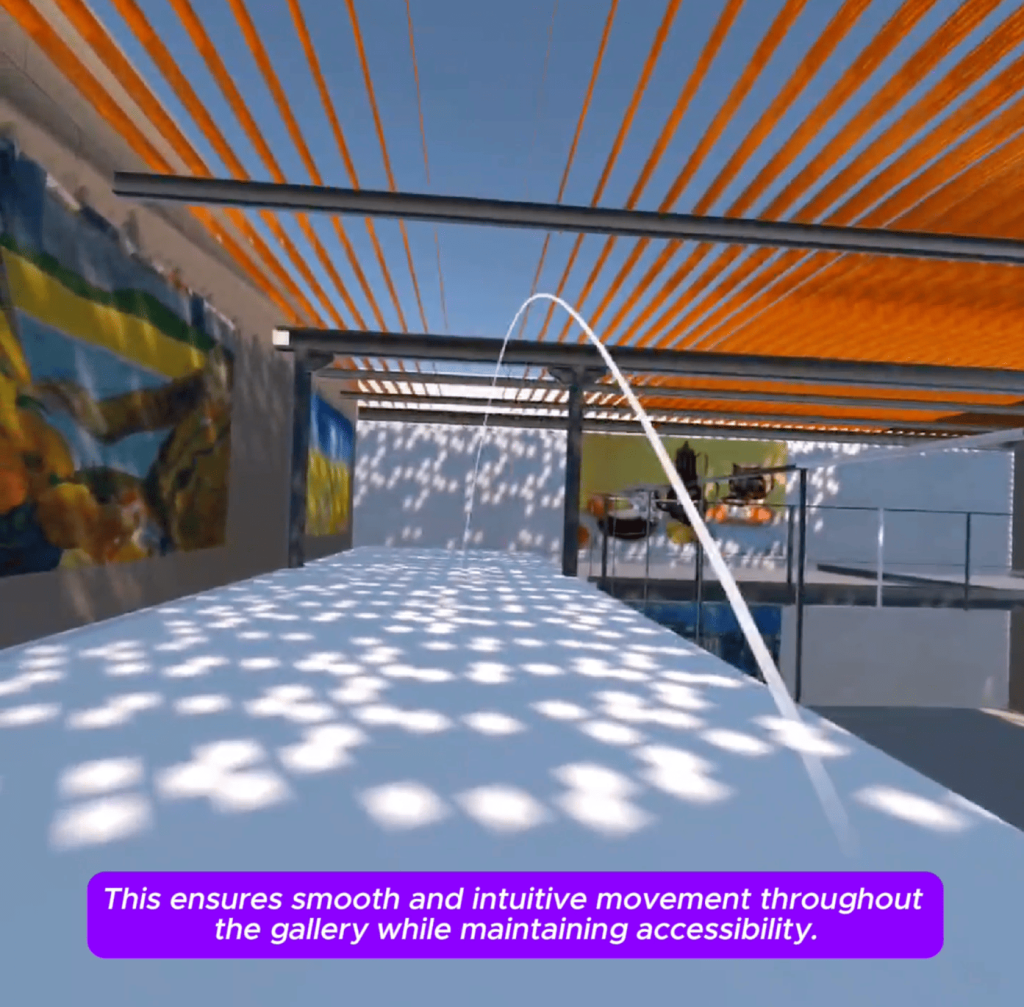
On the above floor, the wood ceiling has been placed with gaps so that anyone who follows the teleportation points and goes toward the first floor can have enough amount of lightning coming from windows and also from the above ceiling to give a natural touch on the above floor. This design mirrors the vibrant and nature-inspired themes of Van Gogh’s works.
Artwork-Presentation:
There are a total of 9 Paintings of Vincent Van Gogh in the museum, Three of them are placed in the lower portion of the museum, two are across the stairs, and the rest of the four artworks are placed on the upper floor with great attention to detail and considering the lightning and right in front of the user teleportation points so if a user standing on the teleported point he can see the painting perfectly with small details.
Audio Integration:
Spatial 3D audio is used in the entire scene, which is created using FMOD and Reaper to make sure the user can hear the ambient music on different volumes in the proximity of the location from each painting. The audio source is positioned in the center of the museum to make sure each corner of the museum is getting sound while exploring the museum.
Methodologies
Tools and Technologies
- Unity: This software is industry-standard software and provides comprehensive support for VR development, allowing for the creation of detailed, immersive environments essential for simulating real-world art gallery experiences.
- Blender: Blender is a powerful tool known for its 3D modeling advanced features, I downloaded a rough model from Sketchfab and then manipulated it according to my needs. I applied all the textures using the texturing feature and manipulated the model using the modeling and UV editing feature within the Blender.
- FMOD: FMOD is a tool that allows us to create, manipulate, and mix sounds in the meta plugins so we can adapt the sounds directly into the scene using Meta Quest Headsets.
- Reaper: Reaper is also a small but useful tool to make sounds 3D as it provides an overview of the sound by giving a visualizer from which we can see the sound directions and adjust it accordingly.
Inspiration and Concept
The inspiration for the virtual art gallery project ideally came after I visited the Vincent Van Gogh Immersive Museum in York, England. In this immersive museum, they are providing a complete walkthrough recorded story-type film where the user can only see the surrounding areas and hear the narration spoken in audio format along with ambient format and has no control over the movement. I found myself in difficulty as I started focusing on some of the details of the artwork and missed some parts of the story while doing that. I paid for the ticket, and yet I can’t go back and see the missed points again, so I decided I need to create an environment in which the user will have more control and can explore whatever he wants the scene guide the user where to go next, but it’s upto to the user if he wants to move on or not. We can tell users they have 30 minutes to complete this tour, and if they want to take a more detailed look, they can repurchase the ticket and then reenter for another 30 minutes to take a deep dive into the artwork.
Development Phase
Initial Phase of Conceptualization
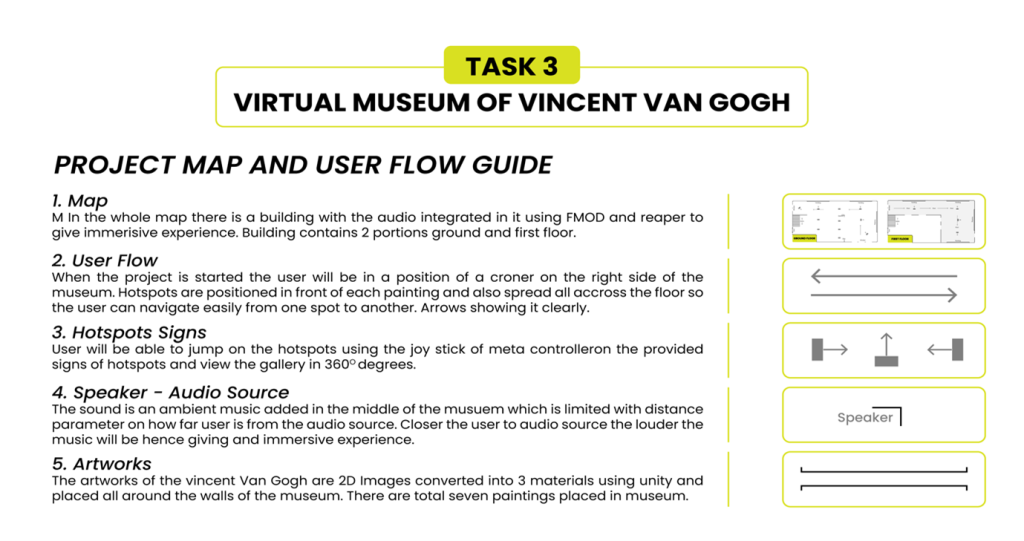
I began by researching existing VR art Projects and the other gaps that I can cover in this project about immersion and user engagement. The goal was to create a space that gives the users more control by remaining optimized with aesthetic appeal and educational depth. To ensure I am on the right path, I created the rough sketches of the model using Adobe Illustrator, as shown below in the figure:
3D Modelling:
I downloaded the gallery model from Sketch Fab and manipulated it according to my needs. The reason why I downloaded it is that it was a perfect model of what I was looking for, and it saved me around 3 hours of work if I had started working from scratch. After refining the model, I created the entire outside with grass texture and other elements like mud and some high peaks, along with a shining sun, to make it a seamless story and more immersive. This way, when the scene starts, the user can feel more natural and thus increase the immersion level, which results in the perfect project.
Audio Integration:
For the audio part, I used FMOD along with some stock assets downloaded from Pixabay to make the audio perfect and ready to use I used ambient sound without the narration of each painting as this will be my next implementation in this project for the next year along with 3D sound with more customized setting.
Visual Integration:
High-quality textures have been added to the scene to make sure the user gets highly detailed visuals so they can see as few details as they want to ensure the visual fidelity and overall natural compositions of the scene.
Testing and Iteration:
After giving multiple tests along with my friends, I discovered that after completing the build, the final rendered output of the walls does not work properly as it flickers when the user tries to move his head. So I edited the model again and then implemented it by removing some extra textures from it to make sure the optimization of the system could handle that load and finally got the desired results.
Challenges and Solutions:
Performance optimization:
- Challenge: High-resolution textures caused the frame rate to drop to a very low level, which makes it hard for a user to make it believe it’s an immersive environment.
- Solution: Textures were optimized using some techniques, and models were made a bit more simplified. The outer environment was also made very simpler as users don’t have access to the outer world and can only view it, so most of the textures are removed from the outer world to make sure the build is perfectly optimized without compromising visual quality.
- Challenge: Developing an extensive VR environment is time-consuming, so I have managed to do 65% right now.
- Solution: I focused on the core features, such as teleportation and user engagement elements, to make it as immersive as possible, but the rest of the features will be implemented throughout the year of my degree.
Evaluation and User Feedback:
Data from different users having different amounts of VR technology knowledge has been obtained together and key findings from the observations are stated below:
Strengths:
Users have mentioned the natural and aesthetic look of the environment, which makes it more immersive, including the 360-degree exploration features and the 3D sound in the environment.
Areas of improvement:
Some users suggested adding multiplayer features to enable a shared experience and make it a more viable option to go with, while others recommended including other elements. apart from the viewing, we added puzzles of Vincent van Gogh paintings that a user can solve using their hand tracking; this allows us to attract younger audiences as well.
Discussion
The Virtual Art Gallery Project demonstrates the transformative potential of VR in cultural education and engagement. By integrating naturalistic design, interactivity, and user-controlled navigation, the project addresses critical gaps in traditional museum experiences. However, it also raises important questions:
Authenticity vs. Digital Replication:
Can digital artworks can provoke the same emotional response as original artworks? Studies like (Oldfield, 2024)suggest that even immersive VR environments cannot fully replicate authenticity.
Sustainability:
Ensuring the platform remains accessible while generating revenue produces a big challenge. Collaborations with the government, educational institutions, and cultural organizations could provide sustainable funding models, and these grants and funding will help to make sure the platform remains up and running as it’s a one-time investment with the potential of a proper revenue stream throughout life. because artworks will remain the same till the end of the earth to get functional. The initiative can cost a big amount in the start, but as it goes on commercially, the revenue and other streams with a not big amount of funding needed can get the project up and running.
Suggestions for Future Research
Personalization in VR:
Future studies must explore how we can make art accessible to everyone as more and more people are going away from art galleries and museums. How can we still provide the same experience in the Virtual world that people can get in the real museum? What are the other aspects we should focus on to preserve our cultural heritage through the use of digital technologies like VR?
Cross-Cultural Communication:
How galleries can investigate and promote cross-culture communication so that people around the world can feel and have emotional attachments towards all human beings living in different areas around the world using Virtual Realities and augmented realities techniques?
Impact on Art Education:
We can develop more immersive more optimized, and user-friendly environments shortly to make art accessible to anyone. Not everyone can afford these big tech-related products to explore these aspects of art, so what other options can we adopt in the current era to make art and galleries more accessible to every person on the earth?
What is the future, and how can art education be changed using these technologies?
these are some of the questions we should be studying so we can sort things out in the near future and help all others who want to explore but they’re not able to do that yet.
Conclusion:
This small-scale project of an immersive virtual art gallery shows us how Virtual Reality can redefine the art experience, making it accessible by using current headset technologies. As known, the inspiration is drawn from a traditional gallery and enhanced accordingly with the new usage of immersive technologies. Overall this project offers a new paradigm to people of exploring cultural values that were buried down in the scenery of the past using new and enhanced technologies.
While the challenges remain, the potential of Virtual Reality in art and education has a lot of potential, As it promises a future where art is no longer tied to a physical space but accessible to every other person on the planet who has the right kind of equipment in his or her hands.

